
Best Faucet Water Filters
Do You Actually Need a Faucet Water Filter? Is a Faucet Water Filter the Right Solution for You?
A faucet-mounted water filter attaches directly to a compatible kitchen or bathroom faucet and filters water as it leaves the tap. It is a practical option for people who want filtered drinking and cooking water without installing an under-sink system. However, a faucet filter is not designed to solve every water problem. The right choice depends on what you want to reduce, whether the specific filter has a verified claim for that contaminant, whether it fits your faucet, and how much replacement cartridges will cost over time. Before choosing a model, identify your water problem first, then compare filtration claims, faucet compatibility, filter capacity, and ongoing cost.
Best Faucet Water Filters at a Glance
The table below provides a quick starting point for shoppers who already know they want a faucet-mounted filter. The “best for” categories are based on specific use cases rather than an overall ranking, since the most suitable filter depends on the contaminants you need to address and your faucet setup.
Best Faucet Water Filters at a Glance
| Model | Best for | Key filtration claims | Capacity | Faucet compatibility |
|---|---|---|---|---|
| PUR PLUS PFM400H | Lead and broader contaminant reduction | Model-specific claims for chlorine, lead, and other listed contaminants | 100 gallons | Compatible threaded faucets |
| Brita Elite Faucet System | Lead, chlorine, taste, and odor | Model-specific claims for lead, chlorine, and other listed contaminants | 100 gallons | Most standard threaded faucets |
| Culligan FM-25 | Lead reduction and higher filter capacity | Model-specific claims for chlorine, particulates, turbidity, and lead | 200 gallons | Compatible standard faucets |
| Waterdrop WD-FC-01 | Basic filtration and longer filter life | Chlorine, taste, odor, sediment, rust, and suspended particles | 320 gallons | Compatible threaded faucets |
| Waterdrop WD-FC-06 | Stainless-steel design and longer filter life | Chlorine, taste, odor, sediment, rust, and suspended particles | 320 gallons | Compatible faucets with supplied adapters |
Product specifications and certification claims can vary between generations and individual models, so verify the exact model number before purchasing.
Do You Actually Need a Faucet Water Filter?
A faucet filter makes the most sense when your goal is to treat water at one particular faucet, especially for drinking and cooking. The important question is not simply whether a faucet filter works, but whether this type of filter addresses the specific water problem you have.
| If your problem is… | A faucet filter may be… | What to consider |
| Chlorine, taste, or odor | A good fit | Look for a filter with a relevant reduction claim |
| Lead | Potentially a good fit | Look for a specific certified lead-reduction claim |
| Sediment or visible particles | Sometimes useful | Check the filter and inspect the faucet aerator and plumbing |
| Hard water or scale | Usually not the right solution | A water softener or another hardness-treatment system may be more appropriate |
| Well water | Depends on the water quality | Test the water first and select treatment based on the results |
| A small screen at the faucet tip | You may need an aerator | An aerator controls water flow rather than filtering contaminants |
For chlorine, taste, and odor, a faucet-mounted filter can be a convenient way to improve the characteristics of water at the point of use. If lead is the concern, however, do not choose a filter simply because it uses a particular filtration technology. Check whether the exact model has a verified claim for lead reduction.
Hard water is a different situation. Hardness is primarily caused by dissolved calcium and magnesium, and a conventional faucet filter is generally not intended to soften water or prevent scale throughout a plumbing system. Similarly, well water should not be treated as a single contaminant problem. Its treatment needs depend on the results of water testing.
There is also an important distinction between wanting filtered water and wanting a small replacement part at the end of a faucet. If the latter is what you need, you may actually be looking for a faucet aerator.
Faucet Water Filter vs Faucet Aerator: Are You Looking for the Right Thing?
A faucet water filter and a faucet aerator can both attach at the outlet of a faucet, but they perform very different jobs. A water filter contains filtration media designed to reduce specific substances from the water. An aerator normally has a screen or mesh that mixes air with the water and helps control the flow pattern.
| Faucet water filter | Faucet aerator | |
| Main purpose | Filter water | Control and shape water flow |
| Filtration media | Yes | Usually no |
| Removes contaminants | Model-dependent | No |
| Reduces splashing | Sometimes | Yes |
| Typical location | Faucet outlet | Faucet outlet |
An aerator can help produce a smoother stream, reduce splashing, and control the amount of water flowing from the faucet. Its screen may also catch larger particles that come from the plumbing, but this should not be confused with contaminant filtration.
If you are searching for a small threaded part with a screen that replaces the existing piece at the end of your faucet, you may need an aerator or strainer rather than a water filter. If your goal is to reduce substances such as chlorine, lead, or other contaminants from drinking water, you need an actual filtration device with a filtration claim that addresses the specific contaminant.
Water Filter Solutions for Pull-Out and Pull-Down Faucets
If you have a pull-out or pull-down kitchen faucet, a standard faucet-mounted water filter usually cannot be attached directly to the spray head. The spray head is connected to a flexible hose and is designed to move, making it unsuitable for most faucet-mounted filter housings.
That does not mean you need to replace your faucet to get filtered water. Several alternatives can provide filtered water while allowing you to keep your existing pull-out or pull-down faucet.
| Solution | How it works | Best for |
|---|---|---|
| Under-sink water filter | Installs below the sink and supplies filtered water through a separate outlet | Most pull-out and pull-down faucets |
| Under-sink filter with dedicated faucet | Filter connects to a separate filtered-water faucet installed beside the main faucet | Drinking and cooking water |
| Integrated filtration faucet | Replaces the existing faucet with a pull-out or pull-down model that has a separate filtered-water line | New faucet installation or replacement |
| Countertop water filter | Sits on the counter and connects to the faucet or uses its own dispensing system | Renter-friendly or no under-sink installation |
For most households with a pull-out or pull-down faucet, an under-sink filter is the most straightforward alternative. The filtration system stays under the counter, while the existing faucet can continue to be used normally. Depending on the system, filtered water may be delivered through a dedicated drinking-water faucet or through a compatible integrated faucet.
If you are replacing your faucet anyway, an integrated filtration faucet can combine the faucet and filtration functions in one installation. These models are specifically designed to accommodate the faucet’s moving spray head while keeping filtered water separate from the regular hot and cold water supply.
The important point is that faucet compatibility should be checked before buying a filter. If your faucet has a pull-out or pull-down spray head, look beyond standard faucet-mounted filters and choose a filtration system designed to work with that type of installation.
Frizzlife MK99 — Best for keeping your existing pull-out or pull-down faucet

Instead of attaching a filter to the spray head, the MK99 installs under the sink and connects directly to the faucet’s cold-water supply line. Filtered cold water then comes out through the existing faucet, so you can keep using the pull-out or pull-down design exactly as before.
This setup provides a similar on-demand experience to a faucet-mounted filter without adding a second drinking-water faucet or replacing the existing kitchen faucet. It is particularly useful when faucet compatibility is the main reason a conventional faucet-mounted filter cannot be used.
How Faucet-Mounted Water Filters Work
A faucet-mounted water filter is installed directly onto the faucet outlet, usually by removing the existing aerator and attaching the filter housing with the appropriate adapter. Once installed, tap water can be directed through the filter cartridge before it reaches the glass or sink.
Inside the housing, water passes through one or more filtration materials. The exact media vary by model, but many faucet filters use activated carbon or other materials designed to reduce specific contaminants. What the filter can reduce depends on the cartridge design and the claims verified for that particular model.
Many faucet-mounted filters have a selector that lets you switch between filtered and unfiltered water. This allows you to use filtered water for drinking and cooking while using the normal faucet flow for tasks such as washing dishes. Not every model has this feature, so it should be checked before purchase.
A filter cartridge also has a limited capacity. Manufacturers typically specify a capacity in gallons or liters, but actual cartridge life depends on water quality and usage. As the cartridge becomes loaded with contaminants or particles, water flow can also decrease. Faucet filters generally have a lower flow rate than an unrestricted faucet because water must pass through the filtration media.
The basic process is simple:
Faucet → Filter housing → Filter cartridge → Filtered water
Understanding this flow helps explain why cartridge capacity, filtration claims, and flow rate all matter when comparing faucet water filters.
How to Tell What a Faucet Filter Can Actually Remove
Faucet filters often advertise reductions for multiple contaminants, but the number of claims on the product packaging should not be treated as a measure of overall filtration performance. The important question is whether the exact model has a verified claim for the specific contaminant you want to reduce.
NSF/ANSI 42 generally covers aesthetic effects such as chlorine, taste, odor, and particulate reduction, depending on the specific certification or performance claim. NSF/ANSI 53 covers certain contaminants with health-related effects, and may include a lead-reduction claim for a particular filter. NSF/ANSI 401 addresses certain emerging or incidental contaminants. However, a product being certified to one of these standards does not mean it removes every contaminant covered by that standard.
| What you want to reduce | What to look for |
| Chlorine | Specific chlorine-reduction claim, often under NSF/ANSI 42 |
| Lead | Specific lead-reduction claim, often under NSF/ANSI 53 |
| Sediment | Specific particulate-reduction claim |
| PFAS | Specific PFAS reduction claim or certification |
| Fluoride | Specific fluoride-reduction claim |
| Hardness | Usually requires a different treatment approach |
There is also an important difference between a certified or independently verified claim and a manufacturer’s general marketing statement. A manufacturer may state that a filter reduces a particular contaminant, but that does not automatically mean the claim has been independently certified.
Best Faucet Water Filters for Different Needs
Once you know that a faucet-mounted filter is suitable for your water problem and compatible with your faucet, the next step is comparing individual models. The products below are organized around specific needs rather than a single “best overall” ranking.
Filtration claims, capacity, flow rate, and compatibility can vary between models and replacement cartridges. For that reason, the most useful comparison is one that connects each product to the type of user it is designed to serve.
| Model | Best for | Certified / verified claims | Filter capacity | Flow rate | Replacement cost | Faucet fit |
| PUR PLUS PFM400H | Lead and broader contaminant reduction | Model-specific claims under NSF/ANSI 42, 53, and 401 | 100 gallons | 0.52 GPM | Varies | Compatible threaded faucets |
| Brita Elite Faucet System | Lead, chlorine, taste, and odor | Model-specific claims under NSF/ANSI 42, 53, and 401 | 100 gallons | 0.58 GPM | Varies | Most standard faucets |
| Culligan FM-25 | Lead reduction and higher cartridge capacity | Model-specific NSF/ANSI 42 and 53 claims | 200 gallons | 0.5 GPM | Varies | Compatible standard faucets |
| Waterdrop WD-FC-01 | Longer filter life and basic filtration | NSF/ANSI 42 and 372 for applicable claims | 320 gallons | Not specified | Varies | Compatible threaded faucets |
| Waterdrop WD-FC-06 | Stainless-steel design and longer capacity | Model-specific filtration and material claims | 320 gallons | 0.5 GPM | Varies | Compatible faucets with supplied adapters |
PUR PLUS PFM400H

Best for: People who want a faucet-mounted filter with specific claims for lead reduction as well as chlorine taste and odor and other listed contaminants.
Filtration: The PFM400H uses a replaceable PUR cartridge designed to reduce multiple contaminants. Its filtration performance varies by the specific cartridge used, so the contaminant list should be checked rather than assuming that every PUR faucet filter has the same capabilities.
Certification: The applicable filter is associated with NSF/ANSI 42, 53, and 401 testing for specific reduction claims. These standards cover different types of filtration performance, but they should not be interpreted as meaning that the filter removes every contaminant associated with those standards.
Capacity: The cartridge is rated for approximately 100 gallons of water.
Flow rate: Its rated service flow is about 0.52 gallons per minute. Actual flow at home can vary depending on water pressure and the condition of the cartridge.
Faucet compatibility: The system is designed for compatible threaded faucets and uses adapters for different faucet connections. The faucet’s aerator and thread configuration should be checked before installation.
Replacement cost: Cartridge prices vary depending on the retailer and package size. Because the filter is rated for 100 gallons, replacement frequency should be considered when calculating long-term ownership cost.
Limitations: The relatively low cartridge capacity means households with high water consumption may need replacements more frequently than with higher-capacity systems. It should also be viewed as a point-of-use filter rather than a solution for treating an entire home’s water supply.
Bottom line: The PFM400H is worth considering when lead reduction is one of your primary concerns and you want a faucet-mounted system with multiple documented filtration claims.
Brita Elite Faucet System
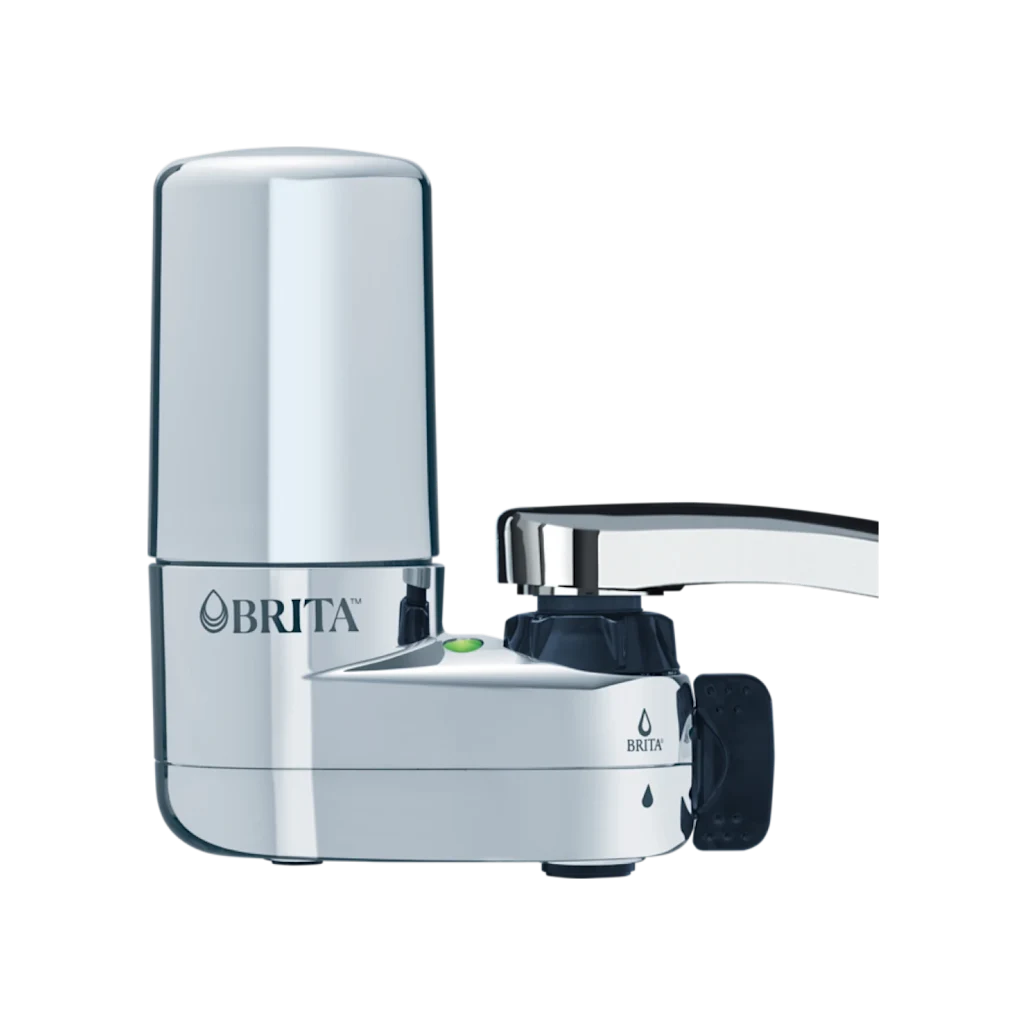
Best for: Households looking for a familiar faucet-mounted system with specific claims for lead, chlorine taste and odor, and other contaminants.
Filtration: The Elite filter is designed to reduce a range of substances, including lead and chlorine-related taste and odor. Its exact capabilities depend on the specific filter model and documented performance claims.
Certification: The applicable Elite filter has performance claims associated with NSF/ANSI 42, 53, and 401. As with other certified filters, the individual contaminant claim is more important than the standard number by itself.
Capacity: The filter is rated for approximately 100 gallons. Actual cartridge life depends on household water consumption and water conditions.
Flow rate: The rated flow is approximately 0.58 gallons per minute under specified test conditions. Household flow may differ because of water pressure, faucet design, and cartridge condition.
Faucet compatibility: The system is intended for many standard faucets, but compatibility is not universal. Specialized faucets, including certain pull-out and pull-down designs, may require a different solution.
Replacement cost: Replacement-filter pricing varies by retailer and package size. With a 100-gallon capacity, the cost per gallon can be more useful than the cartridge price alone when comparing it with other models.
Limitations: The filter is intended for specific contaminant reduction rather than comprehensive water purification. It also does not address problems such as whole-house water hardness.
Bottom line: The Brita Elite is a practical choice for users who want a mainstream faucet filter with documented contaminant-reduction claims and straightforward point-of-use filtration.
Culligan FM-25
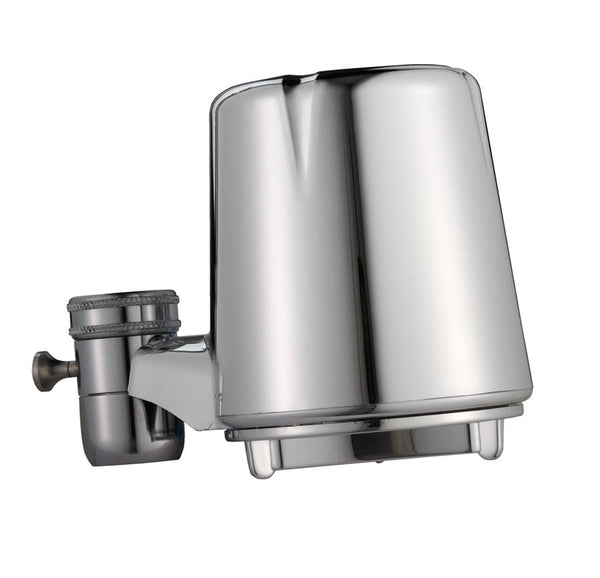
Best for: Users who want a faucet filter with a 200-gallon cartridge and specific claims for lead and other common tap-water contaminants.
Filtration: The FM-25 is designed to reduce chlorine, particulate matter, turbidity, lead, and several other listed contaminants. Its performance claims apply to specific contaminants rather than to water quality in general.
Certification: The FM-25 has documented performance associated with NSF/ANSI 42 and 53 for its applicable claims. This makes it important to look at the individual contaminant claims instead of treating the certification standard as a general guarantee of filtration performance.
Capacity: The cartridge is rated for up to 200 gallons, giving it twice the nominal capacity of many 100-gallon faucet filters.
Flow rate: The rated flow is approximately 0.5 gallons per minute. This is relatively typical for a faucet-mounted filtration system.
Faucet compatibility: The FM-25 is designed to connect to compatible standard faucets using the appropriate adapter. The faucet connection should be checked before purchase, particularly if the faucet has a non-standard design.
Replacement cost: The replacement cartridge cost depends on the seller and package size. Its 200-gallon capacity can help reduce replacement frequency, but the actual annual cost depends on household usage.
Limitations: A higher cartridge capacity does not necessarily mean broader filtration performance. The FM-25 should still be selected based on the specific contaminants it is documented to reduce.
Bottom line: The FM-25 is a useful option for households that want a faucet-mounted filter with a relatively high cartridge capacity and specific contaminant-reduction claims.
Waterdrop WD-FC-01
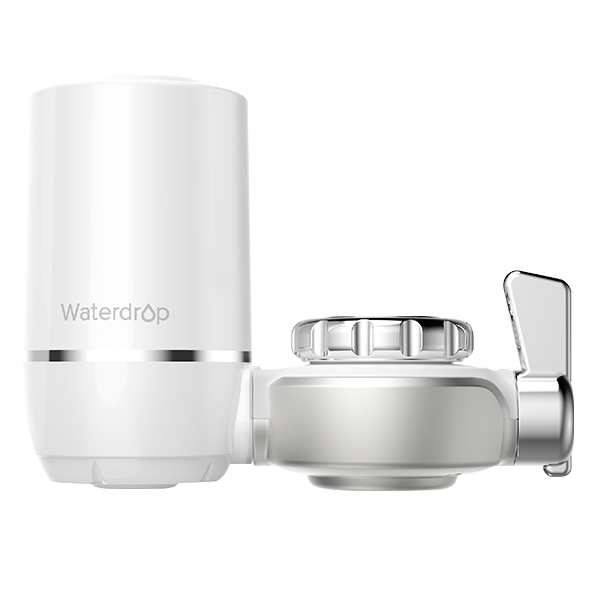
Best for: Users who prioritize longer cartridge capacity and reduction of chlorine, taste, odor, and particulate matter.
Filtration: The WD-FC-01 uses carbon-based filtration designed to improve several common characteristics of tap water and reduce listed contaminants such as chlorine, sediment, rust, and suspended particles.
Certification: Its documentation includes NSF/ANSI 42 and NSF/ANSI 372 information for applicable claims. These two standards should not be confused: NSF/ANSI 372 relates to lead content in materials, not certification that the filter removes lead from drinking water. Anyone specifically looking for lead reduction should therefore look for a separate, model-specific lead-reduction claim.
Capacity: The cartridge is rated for up to 320 gallons, which is substantially higher than many 100-gallon faucet filters.
Flow rate: A specific rated flow should be confirmed for the exact version being purchased rather than assuming that all WD-FC-01 configurations have identical performance.
Faucet compatibility: The system is intended for compatible threaded faucets and uses adapters to accommodate different connection types. The faucet’s existing aerator and thread configuration should be checked before purchase.
Replacement cost: Replacement cartridges are generally sold in multipacks, so the cost per cartridge and cost per gallon can be useful measures when comparing long-term ownership.
Limitations: The longer cartridge capacity does not mean that the filter removes more types of contaminants than competing models. In particular, material-related certification should not be presented as evidence of lead removal.
Bottom line: The WD-FC-01 is better suited to buyers who value longer cartridge life and basic tap-water filtration than to those specifically seeking a certified lead-reduction filter.
Waterdrop WD-FC-06

Best for: Users who want a faucet-mounted filter with stainless-steel construction and a relatively high cartridge capacity.
Filtration: The WD-FC-06 uses carbon-based filtration intended to reduce substances such as chlorine, taste and odor, sediment, rust, and suspended particles. The exact claims should be matched to the cartridge version used with the system.
Certification: The applicable filter documentation includes NSF/ANSI 42 and NSF/ANSI 372 information for specific purposes. As with other products in this category, NSF/ANSI 372 concerns material composition and should not be interpreted as a certified lead-removal claim.
Capacity: The cartridge is rated for approximately 320 gallons.
Flow rate: The rated flow is approximately 0.5 gallons per minute, although actual household flow can vary with water pressure and cartridge condition.
Faucet compatibility: The system is designed to connect to compatible faucet threads and includes adapters for different connection configurations. Compatibility should still be confirmed with the actual faucet before purchase.
Replacement cost: The long cartridge capacity can reduce replacement frequency, but the most useful comparison is the cost per gallon based on the current replacement-cartridge price and its rated capacity.
Limitations: Stainless-steel construction is primarily a design and durability consideration; it does not by itself indicate better contaminant removal. Filtration performance should be judged from the specific claims associated with the cartridge.
Bottom line: The WD-FC-06 is worth considering if you want a higher-capacity faucet filter with a stainless-steel housing and your water problem matches its documented filtration capabilities.
How Much Does a Faucet Water Filter Cost to Own?
The purchase price is only part of the cost of a faucet water filter. A filter that costs $25 initially may become more expensive to use if its replacement cartridges are costly or have a relatively low capacity. Conversely, a higher-priced system can have a lower ongoing cost if its cartridges last longer.
To compare faucet filters more realistically, consider the initial unit price, replacement cartridge price, rated cartridge capacity, and how much filtered water your household uses.
A simple way to estimate annual cartridge cost is:
Annual filter cost ≈ cartridge price × annual water usage ÷ cartridge capacity
For example, if a replacement cartridge costs $10, has a rated capacity of 100 gallons, and your household uses 200 gallons of filtered water per year, you would need approximately two cartridges per year. Your estimated annual cartridge cost would therefore be about $20.
The same calculation can be used to compare filters with different capacities. A $15 cartridge rated for 100 gallons costs about $0.15 per gallon, while a $25 cartridge rated for 300 gallons costs about $0.08 per gallon. The higher cartridge price does not necessarily mean the filter costs more to operate.
When comparing models, also remember that rated capacity is not a guarantee of actual cartridge life. Water quality, sediment levels, and household usage can affect how quickly a cartridge needs to be replaced.
For a more accurate comparison, calculate the estimated cost over one year rather than comparing the purchase prices alone. This gives you a clearer picture of what each faucet filter will cost to own and use.
Is a Faucet Water Filter the Right Solution for You?
A faucet-mounted filter is designed for a specific use case: providing filtered water directly from a compatible faucet without requiring a larger filtration installation. It is not necessarily the appropriate solution for every water-treatment need.
| If your priority is… | Consider |
| Filtered drinking water without permanent installation | Faucet filter |
| A simple, low-cost filtration option | Faucet filter or pitcher |
| Avoiding faucet compatibility issues | Pitcher |
| Higher filtered-water capacity | Under-sink filter |
| Broader or more specialized treatment | Under-sink, reverse osmosis, or specialized system |
| Reducing hardness and scale | Water softener |
| Treating water throughout the home | Whole-house system |
| An unknown problem with well water | Test the water first |
If you mainly want filtered drinking and cooking water from your existing faucet, a faucet filter can fit that use case without requiring a larger installation. A pitcher may be more suitable when you do not want to modify or connect anything to the faucet.
If you need a larger supply of filtered water, an under-sink system is designed for higher-capacity point-of-use filtration. More specialized water problems may require reverse osmosis or another treatment system selected for the specific contaminant.
Hard water is a separate case because the primary issue is dissolved minerals that cause scale. A conventional faucet filter is generally not designed to soften water throughout a plumbing system. For whole-house treatment, the appropriate system depends on the water problem and the treatment objective.
For well water, testing should come before choosing a filter when the water quality problem is unknown. The test results can help determine whether a faucet filter is appropriate or whether a different treatment approach is needed.