
Electronic Water Descaler
Is This the Solution You Are Looking For?
If you are looking for an electronic water descaler, you may already know that scale buildup is the problem you want to address. The real question is whether a descaler can make a meaningful difference in your particular situation.
An electronic descaler is designed to reduce the effects of scale rather than remove the minerals responsible for water hardness. If your main concern is scale affecting plumbing, fixtures, water heaters, appliances, or other water-contact surfaces, the sections below explain what an electronic descaler can realistically do and where its limits are.
What Does an Electronic Water Descaler Actually Do?
An electronic water descaler is a device designed to reduce the formation and adhesion of hard-water scale in plumbing and water-using appliances. It typically uses an electronic signal or electromagnetic field applied around the water line to influence how dissolved minerals behave as scale forms.
Unlike a water softener, it does not remove calcium, magnesium, or other hardness minerals from the water. The goal is to change how those minerals crystallize so that the resulting deposits are less likely to form stubborn, tightly bonded scale on water-contact surfaces.
Helps Control New Scale Buildup
The main purpose of an electronic descaler is scale control.
When water containing hardness minerals passes through the treatment area, the device is intended to influence the way those minerals crystallize. If the treatment works as intended, the resulting mineral deposits may be less strongly attached to surfaces such as pipes, faucets, showerheads, water heaters, and appliances.
This is primarily a preventive or ongoing effect rather than an instant cleaning process. Turning on an electronic descaler does not simply dissolve existing layers of scale. Its intended role is to change how new deposits form after installation.
The actual results can depend on factors such as water chemistry, temperature, flow conditions, the surfaces involved, and the particular technology used by the device.
What It Does Not Do
An electronic water descaler does not remove the minerals that cause hard water. Calcium and magnesium remain dissolved in the water, so the treatment does not make hard water chemically soft in the way an ion-exchange water softener does.
It also is not a filtration or purification system. An electronic descaler should not be expected to remove contaminants or specifically treat substances such as chlorine, iron, or manganese unless a separate treatment system is used for those purposes.
Because the dissolved minerals remain in the water, an electronic descaler also does not function as a TDS-reduction system.
In simple terms, an electronic water descaler is a scale-management device, not a mineral-removal system. It is intended to reduce the formation or adhesion of troublesome scale while leaving the underlying mineral content of the water largely unchanged.
If your goal is to actually reduce water hardness or remove dissolved substances, you need a different type of water-treatment system, such as a water softener or an appropriate filtration technology.
| What you want | Electronic Descaler | Water Softener |
| Reduce scale formation | ✓ | ✓ |
| Remove hardness minerals | No | Yes |
| Change water hardness | No | Yes |
| Reduce scale-related deposits | ✓ | ✓ |
| Salt required | Typically no | Typically yes |
| Maintenance | Low | Higher |
| Main purpose | Scale control | Water softening |
How to Choose an Electronic Water Descaler
The next question is whether a particular unit is suitable for your home. The important differences are not simply the brand or the price. They include the size of the water system, the way the device is installed, how its electronic signal is delivered to the pipe, and what is required to keep it operating.
The following factors can help you compare models before choosing one.
Coverage and Water Flow
Start with the size of the water system the device is designed to cover. Some electronic descalers are intended for a typical residential water supply, while others are designed for smaller apartments or larger homes with higher water demand.
Coverage claims should not be interpreted only as the number of bedrooms or bathrooms. Water flow and the configuration of the plumbing system can also matter. A larger home with several bathrooms and multiple appliances operating at the same time may place different demands on the system than a small apartment with a single main water line.
If the manufacturer specifies a maximum flow rate, pipe size, or recommended property size, use those specifications rather than assuming that a more powerful-looking unit will automatically provide better results.
For whole-house applications, the most important question is whether the device is designed for the main water line serving the property. For a smaller installation, check whether the manufacturer specifically supports the intended plumbing configuration.
Pipe Compatibility
The device also needs to be compatible with the pipe it will be installed on. Check the supported pipe diameter before purchasing, particularly if the unit uses an external coil that must be wrapped around the pipe.
Pipe material can also be relevant. Many electronic descalers are designed to work with common residential plumbing materials, but the installation instructions may specify particular requirements or limitations.
Pay attention to how the manufacturer defines pipe size. A product may refer to nominal pipe size rather than the actual outside diameter, which can make a difference when installing an external coil.
The installation location matters as well. If the device is intended for the main incoming water line, make sure there is enough accessible pipe in the recommended location to install the unit correctly.
Signal and Coil Design
For models that use an external wrapping coil, the coil is an important part of the installation rather than just an accessory.
The manufacturer may specify the required coil length, number of wraps, spacing between wraps, or the section of pipe where the coil should be installed. These instructions should be followed rather than treating the coil as something that can simply be wrapped around the pipe in any convenient way.
Different products can use different coil designs and installation requirements. Some may require multiple wraps around the pipe, while others may use a different arrangement for delivering the electronic signal.
If you are comparing two coil-based descalers, therefore, do not assume that the device with more visible wire or more wraps is necessarily more effective. What matters is whether the installation method matches the manufacturer’s design and specifications.
Installation
Installation can range from a simple DIY setup to a job that requires access to the home’s electrical and plumbing systems.
Many external electronic descalers do not require cutting into the water line. Instead, the electronic unit is mounted outside the pipe and the coil or signal cable is installed around the pipe. This can make installation considerably simpler than installing equipment directly into the plumbing.
However, the electrical side still needs attention. A plug-in device may only require a suitable power outlet, while another installation may require additional electrical work depending on where the equipment is located.
Before choosing a model, check whether it is genuinely DIY-friendly, whether mounting hardware is included, how the signal cable must be installed, and whether the power supply can be positioned safely near the installation point.
If the manufacturer’s instructions require electrical work or a permanent electrical connection, using a qualified electrician may be appropriate.
Power Consumption
Electronic water descalers normally need a continuous power supply while operating. This makes power consumption another useful specification to compare.
Look for the manufacturer’s stated power consumption or electrical rating rather than estimating electricity use from the adapter alone. The adapter’s voltage and current ratings describe the power supply requirements, but they do not always provide the same information as the device’s actual operating consumption.
For a continuously powered device, even relatively small differences in consumption can add up over time. However, electricity use is generally only one part of the operating cost. It should be considered together with installation, maintenance, replacement parts, and the expected service life of the unit.
Maintenance
One of the practical attractions of electronic water descaling is that the system does not use salt in the same way as a conventional ion-exchange water softener.
There is no salt tank to refill and no softener regeneration cycle to manage. This can make the day-to-day operation simpler for homeowners who do not want the ongoing handling associated with a traditional softener.
That does not mean every electronic descaler is completely maintenance-free. The actual requirements depend on the product. Some models may require little more than checking the installation and power supply, while others may have additional components or manufacturer-specific maintenance instructions.
Do not assume that a descaler eliminates filter replacement, servicing, or other maintenance unless the specific product documentation confirms it. A claim such as “no filter replacement” should be treated as a product-specific feature, not a general characteristic of every electronic water descaler.
Warranty and Support
Warranty is particularly important when comparing electronic descalers because the device depends on an electronic control unit and power supply rather than simply acting as a passive component of the plumbing system.
Check the length of the warranty, what components are covered, and whether the warranty applies to the original purchaser. It is also worth checking whether the manufacturer provides installation guidance, troubleshooting information, replacement parts, and a clear process for making a warranty claim.
Support can become especially important if the device requires a specific coil arrangement or installation configuration. A product with clear documentation can be easier to install and troubleshoot than one with limited instructions, even when the basic technology appears similar.
When comparing products, therefore, look beyond the headline warranty period. The quality and availability of manufacturer support can also affect the practical value of the system over its usable life.
Best Electronic Water Descalers
There is no single model that makes sense for every installation. Pipe diameter, pipe material, available space, electrical access, household size, and the amount of water flowing through the system can all affect which device is appropriate.
The three models below take somewhat different approaches to installation and coverage. Rather than ranking them from best to worst, it is more useful to look at what each one is designed to do and where its limitations matter.
YARNA CWD24
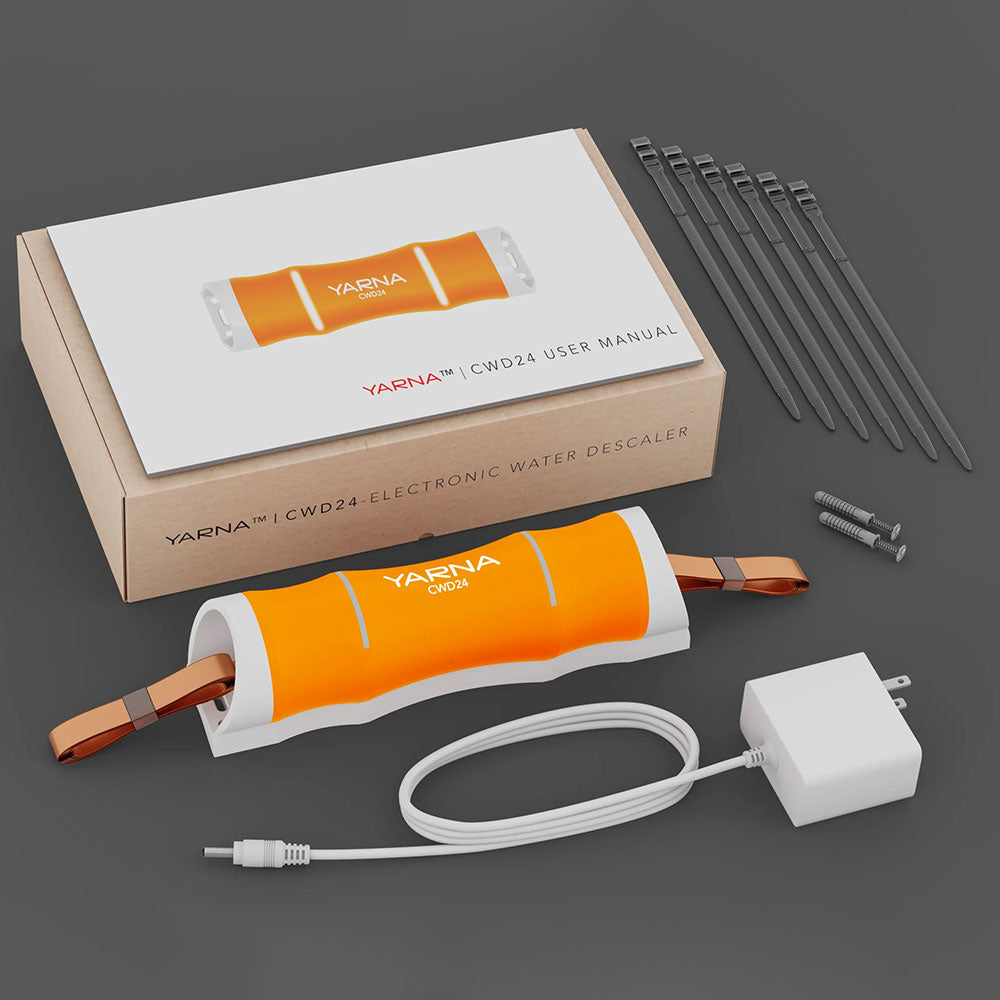
Best for: homeowners who want a clamp-on electronic descaler for a typical residential main water line.
Why it stands out
The YARNA CWD24 uses capacitive electronic treatment with two impulse bands wrapped around the outside of the pipe. The installation does not require cutting into the plumbing, adding a bypass loop, or installing the device inline with the water supply.
The CWD24 is designed for pipes from 3/8 inch up to 1 inch in diameter. YARNA also offers larger CWD30 and CWD48 models for pipes up to 2 and 4 inches respectively, so the product line can accommodate installations beyond the standard residential 1-inch main.
The device requires an electrical connection, but the water line itself remains physically unchanged. YARNA specifies compatibility with metal and plastic pipe materials, including copper, steel, PVC, and PEX.
Installation is primarily a matter of mounting the control unit, wrapping the impulse bands tightly around the pipe, securing them, and connecting the power supply. That makes it particularly relevant for homeowners who want to avoid plumbing modifications.
YARNA states that its products come with a 365-day money-back guarantee.
Key limitation: the CWD24 is limited to a maximum 1-inch pipe diameter. If your main water line is larger, you need to look at another model in the YARNA range rather than assuming the CWD24 will provide the same coverage.
Who should consider it
The CWD24 makes the most sense for a homeowner with a conventional residential water line who wants a whole-house scale-control device without changing the plumbing. It is also worth considering if DIY installation and compatibility with different pipe materials are important factors.
Who should skip it
Skip the CWD24 if your incoming pipe is larger than 1 inch or if your objective is to actually reduce calcium and magnesium from the water. An electronic descaler is not a substitute for an ion-exchange water softener when softened water is the goal.
iSpring ED2000
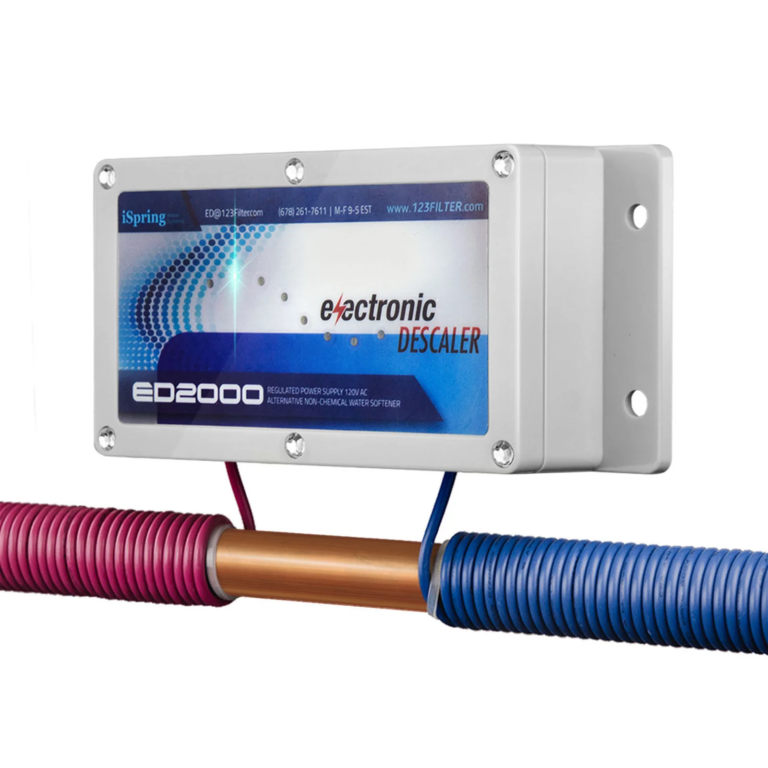
Best for: homeowners looking for a straightforward electronic descaler with broad pipe-material compatibility and a relatively simple installation.
The iSpring ED2000 uses two antenna cables wrapped around the main water pipe to create an electromagnetic field. The device is installed on the incoming main line before it branches toward the water heater and other plumbing.
The ED2000 is designed around a 1-inch pipe. iSpring states that it works with common plumbing materials including PVC, PEX, copper, steel, and other pipe types.
One practical consideration is coverage. iSpring states that the standard ED2000 is suitable for about 50 feet of piping and notes that additional units may be needed in some larger or more complex installations. Homes with water mains larger than 1 inch may also require a different configuration.
The ED2000 does not require cutting the pipe or modifying the plumbing. However, it does require access to electrical power, and the installation manual specifies a 110–120V version for some markets and a 230–240V version for others, so buyers should verify the version supplied for their location.
iSpring also explicitly states that the ED2000 does not remove calcium or magnesium. It is therefore a scale-control device rather than a conventional water softener.
Key limitation: the 1-inch pipe limitation and the manufacturer’s stated coverage considerations make this less straightforward for larger homes or installations with long or complex plumbing runs.
Who should consider it
The ED2000 is worth considering if you have a conventional residential plumbing system, a main line around 1 inch, and want an electronic device that can be installed without opening the water line.
It can also make sense when pipe material is a concern because iSpring explicitly supports both plastic and metal plumbing.
Who should skip it
Skip it if your main line exceeds the recommended size, your installation has unusually long or complicated plumbing runs, or your real objective is to reduce the hardness minerals themselves.
It is also not a complete treatment solution for unrelated water-quality problems. iSpring specifically notes that high iron levels can interfere with the system and recommends iron treatment when iron exceeds 0.3 ppm.
Eddy Electronic Water Descaler

Best for: homeowners who want a simple electromagnetic, DIY installation and place particular value on a long manufacturer warranty.
The Eddy uses electromagnetic treatment delivered through two coils wrapped around the incoming water pipe. Like the other electronic descalers in this category, it does not require the pipe to be cut or modified. The manufacturer describes the installation as a DIY process that can be completed without a plumber.
The standard Eddy configuration is intended for pipes up to approximately 22 mm, with larger-pipe options available through different cables or configurations. The manufacturer describes the system as suitable for common metal and plastic pipe materials, while the retailer specification advises against lead pipe.
Eddy is rated for a maximum flow rate of 50 L/min on the UK product specification and operates from a 110–240V supply.
One of Eddy’s more notable differences is its warranty structure. The manufacturer advertises a 12-month money-back guarantee together with a lifetime repair or replacement guarantee against unit failure.
Key limitation: the standard unit is not the obvious choice for a large-diameter main line or a high-demand installation. Buyers also need to pay attention to the exact cable configuration and pipe diameter rather than assuming that the standard kit fits every household plumbing system.
Who should consider it
Eddy is worth considering if you want a straightforward clamp-on electronic descaler, prefer DIY installation, and place significant value on long-term warranty coverage.
It can also be a practical option for a typical household where the incoming pipe is within the standard cable range and the installation location has access to electricity.
Who should skip it
Skip the standard Eddy configuration if your main water pipe is substantially larger than its supported cable size or if your installation requires a higher flow capacity than the standard specification provides.
You should also look elsewhere if your goal is to produce genuinely softened water rather than reduce the tendency for scale to form.
How These Three Options Differ
The important differences are not simply brand names. They are mainly related to the installation configuration, pipe size, and the type of electronic treatment used.
| Factor | YARNA CWD24 | iSpring ED2000 | Eddy |
| Treatment approach | Capacitive electronic | Electromagnetic | Electromagnetic |
| Standard pipe size | Up to 1 inch | Up to 1 inch | Standard kit up to about 22 mm |
| Pipe installation | External bands | External coils | External coils |
| Pipe cutting required | No | No | No |
| Salt required | No | No | No |
| Plumbing modification | No | No | No |
| DIY installation | Yes | Yes | Yes |
| Electricity required | Yes | Yes | Yes |
| Warranty / guarantee | 365-day money-back guarantee | Product warranty / support varies by market | 12-month money-back + lifetime repair/replace |
| Larger pipe options | CWD30 / CWD48 | Different configurations may be required | Larger cables available |
| Main consideration | Pipe diameter and model selection | Coverage and pipe diameter | Standard cable size and flow |
| Check Price | Check Price | Check Price At Amazon.com |
The table should be treated as a buying guide rather than a performance ranking. Electronic descalers are not interchangeable simply because they all use an external electrical or electromagnetic treatment method.
Before buying, confirm the diameter of the actual pipe where the device will be installed. That single measurement can eliminate several apparently suitable products.
Electronic Water Descaler Installation: What to Know Before You Buy
One of the main differences between an electronic water descaler and an inline water-treatment system is how little plumbing work is normally involved.
Most electronic descalers are installed externally. The treatment wires or bands are wrapped around the existing water pipe, while the electronic control unit is mounted nearby and connected to a power source. That means the installation questions are usually about access, pipe size, coil placement, and electricity rather than cutting and rerouting the plumbing.
Do You Need a Plumber?
Usually, no.
The products covered above are designed for external installation and do not require the main water line to be opened. YARNA describes its installation as a process that requires no plumbing work, while iSpring and Eddy similarly provide DIY installation instructions for their electronic descalers.
That said, the absence of plumbing work does not mean every installation is equally easy. If the main water line is difficult to access, is inside a wall, or has very limited space around it, professional help may still be useful.
Can You Install It Yourself?
In many homes, yes.
The typical process involves locating the incoming water pipe, mounting the control unit, wrapping the supplied wires or bands around the pipe according to the manufacturer’s instructions, securing them, and connecting the power supply.
The important part is following the installation pattern for the specific model. For example, iSpring specifies how its two coils should be wrapped around the pipe, while YARNA uses its own impulse-band configuration.
DIY installation is therefore realistic, but the manufacturer’s instructions should take priority over generic installation advice.
Does It Need to Be Cut Into the Pipe?
No, not for the external electronic descalers discussed here.
The treatment components are installed around the outside of the existing pipe. There is no need to cut the pipe, install a bypass valve, or interrupt the water supply simply to install the electronic treatment unit.
This is one of the main practical reasons homeowners consider electronic descalers instead of conventional inline treatment systems.
Does It Need Electricity?
Yes.
Electronic descalers require an electrical power source for the control unit. YARNA specifies external power adapters for its residential models, while iSpring’s ED2000 and Eddy also require electrical power.
This means you should identify both the pipe location and the nearest suitable electrical outlet before purchasing.
Do not assume that an electronic descaler can be installed anywhere the water pipe is accessible. A location with no practical access to electricity may require a different water-treatment approach.
Does It Work on PEX, Copper, PVC, or CPVC?
Many electronic descalers are designed to work with both metal and plastic plumbing.
For example, iSpring states that the ED2000 can be used with PVC, PEX, and metal pipes. YARNA also lists metal and plastic pipe materials among its compatible applications.
However, compatibility should always be checked against the exact model rather than assumed from the product category. Pipe diameter can be just as important as pipe material.
Where Should the Coils Go?
For a whole-house installation, the usual location is the incoming main water line before it branches to individual fixtures and appliances.
iSpring specifically recommends installing the ED2000 where the main water line enters the house, before it splits toward the water heater and other plumbing.
The exact coil arrangement depends on the product. Some systems use two separate wires, while others use wider impulse bands. The coils or bands should be installed according to the manufacturer’s specified direction, spacing, and number of wraps.
The practical goal is to place the treatment at a suitable point on the main line while leaving enough room to install the coils correctly.
Before buying, check three things at the proposed installation point: the pipe diameter, the pipe material, and the distance to a suitable power outlet. Those details are more useful than simply knowing the total square footage of the house.
Final Decision: Is an Electronic Water Descaler Right for You?
The decision becomes much simpler once you separate scale control from water softening and from other water-quality problems.
An electronic water descaler may make sense if:
Your main concern is mineral scale forming on plumbing, fixtures, water heaters, or appliances.
You do not need to remove calcium and magnesium from the water itself.
You prefer a low-maintenance approach that does not require salt, regeneration cycles, or regular media replacement.
You want to avoid cutting into the existing plumbing.
You want scale control for a whole-house water line and have a suitable installation point with access to electricity.
Consider a water softener instead if:
Your primary objective is to actually reduce the hardness minerals in the water.
You specifically want the characteristics of softened water rather than simply reducing the tendency for scale to form.
Soap performance, laundry, water feel, or measurable water hardness is more important to you than avoiding scale alone.
A conventional ion-exchange softener is designed to reduce calcium and magnesium hardness; an electronic descaler is not. For example, Aquasana describes its SimplySoft system as using ion exchange to reduce hard minerals and carries NSF/ANSI 44 certification for hardness reduction.
You may need another type of treatment if:
Your problem is sediment, sand, rust, or suspended particles.
You need to reduce chlorine, taste, or odor.
You have elevated iron or other specific contaminants.
You are concerned about microbial contamination.
You need treatment for a particular water-quality parameter that an electronic descaler is not designed to address.
An electronic descaler is fundamentally a scale-control device. It should not be treated as a general-purpose water purification system.
The simplest decision
Scale is the main problem → an electronic water descaler may be worth considering.
You want lower water hardness → look at a water softener.
You have a contaminant or water-quality problem → identify that specific problem first and choose treatment designed for it.
You have more than one problem → you may need a combination of treatments rather than expecting one device to solve everything.
If scale is the problem you’re trying to solve, compare the electronic water descalers above based on your home, pipe diameter, pipe material, installation location, electrical access, and the type of scale-control system you prefer.