
Best Countertop Water Filters
What Is It Like to Use a Countertop Water Filter Every Day?
A countertop water filter is the best choice for people who want filtered drinking water at home without installing a filtration system under the sink or modifying their plumbing. The main difference is simple: the filter sits on your kitchen countertop and provides filtered water where you actually use it. However, countertop systems are not all used in the same way. Some have a built-in water reservoir, some connect directly to a faucet, and others use electricity to automate the filtration and dispensing process. This guide focuses on what these systems are actually like to use every day, their practical advantages and drawbacks, and which type makes the most sense for different needs.
What Makes a Countertop Water Filter a Good Choice?
The first question is not which model you should buy, but whether a countertop water filter fits the way you want to use a water filter at home.
A countertop system can make sense if you want filtered water without dealing with a complicated installation. Most systems do not require you to modify your plumbing, install anything inside a cabinet, or make permanent changes to your kitchen. You simply keep the unit on the counter and use it when you need filtered water.
This can be particularly convenient if you live in an apartment or rental property, do not want to work on your plumbing, or simply prefer a filtration system that you can install yourself. It also gives you filtered water directly at the point where you prepare drinks, cook, or fill a glass.
Another practical advantage is portability. A countertop filter is generally easier to move than an under-sink system. If you change where you keep your appliances, move to another home, or want to take the system with you, there is usually much less installation involved.
For some households, a countertop filter can also reduce the need to buy bottled water. Instead of storing and carrying bottles, you can keep the filtration system in the kitchen and produce filtered water whenever you need it.
There are some tradeoffs, however. The biggest one is that the system needs space on your countertop. Depending on the design, you may also need to refill a water reservoir regularly, connect the unit to a faucet, or keep it near an electrical outlet. Filters and other components also need periodic cleaning or replacement.
Speed can be another consideration. Some countertop systems produce filtered water almost immediately, while others need more time to process the water. If several people in your household use a lot of filtered water throughout the day, the difference can become noticeable.
In other words, a countertop water filter is most suitable when you value simple installation, easy access, and having the system directly on your counter more than having a completely hidden filtration system.
What Is It Like to Use a Countertop Water Filter?
The specifications on a product page can tell you the capacity, dimensions, and filtration rate, but they do not always tell you what using the system actually feels like. For a countertop filter, everyday convenience often comes down to a few simple things: how you add water, how you collect filtered water, how often you refill it, and how much attention the system needs.
How Do You Put Water Into It?
Countertop water filters generally handle incoming water in one of a few ways.
The simplest systems have a built-in reservoir. You fill the reservoir with tap water, place it back into the unit if necessary, and let the system filter the water. This approach does not require a connection to your faucet, but you need to remember to refill the reservoir.
Some systems connect directly to your kitchen faucet. Instead of manually filling a tank, tap water flows into the filter through a hose or faucet connection. This can make continuous use more convenient, especially when you need a larger amount of filtered water.
Electric countertop purifiers may also have a reservoir, but the filtration and dispensing process is controlled by the machine. You fill the tank, select the desired function, and let the system handle the rest.
Before buying, it is worth checking exactly how water enters the system because this can have a bigger effect on daily convenience than the filtration technology itself.
How Do You Get the Filtered Water?
The way filtered water is delivered also varies between countertop systems.
With a basic reservoir-style filter, you may simply wait for the water to pass through the filter and collect it in a container or built-in reservoir. This is straightforward, but you may need to plan ahead if the system filters water relatively slowly.
Some systems dispense filtered water automatically after the filtration process. This can be more convenient if you regularly fill glasses, bottles, or cooking containers.
Faucet-connected systems can provide filtered water directly from the connected outlet, so there is less need to wait for a separate tank to process the water.
Electric countertop systems can offer the most automated experience. Depending on the model, you may be able to select an amount of water or start dispensing with a button rather than manually handling the filtration process.
The important point is that “countertop water filter” does not describe one specific user experience. Two systems can both sit on your counter while working very differently.
How Often Do You Need to Refill It?
If the system uses a water reservoir, refill frequency depends mainly on the size of the tank and how much filtered water your household uses.
A small reservoir may be perfectly adequate for one person who drinks a few glasses of filtered water throughout the day, but it can become inconvenient in a larger household. If you frequently fill bottles or use filtered water for cooking, a larger reservoir can save you from repeatedly adding tap water.
A larger tank is not automatically better, though. It also takes up more space and can be heavier when full.
The practical question is therefore not simply how large the reservoir is, but whether its capacity matches your normal daily water use.
How Fast Does It Produce Water?
Filtration speed can make a noticeable difference in how convenient a countertop system is.
Some filters can provide water almost as quickly as you need it, while others process water gradually through a filter or membrane. A system with a small reservoir and slower filtration may require more planning if you regularly need several liters of filtered water.
Think about how you actually use filtered water. If you mainly fill a glass or bottle occasionally, a slower system may not be a problem. If you want to fill several bottles, prepare food, or supply filtered water for an entire household, production speed becomes much more important.
When comparing products, look for both the reservoir capacity and the stated filtration or production rate rather than considering either number on its own.
How Much Cleaning Does It Need?
A countertop water filter still needs basic maintenance even if the filtration process itself is automatic.
Reservoirs and water-contacting parts may need regular cleaning to prevent buildup and keep the system in good condition. Some models have removable tanks and components that are easy to wash, while others require more careful cleaning around internal parts.
You should also check how often the filter cartridge or other replaceable components need to be changed. A system that is easy to use but difficult to clean or maintain can become less convenient over time.
For everyday use, simple maintenance is generally more important than having a long list of features.
Does It Need Electricity?
Not every countertop water filter needs an electrical connection.
Basic gravity-fed or faucet-connected systems may operate without electricity. This can make them easier to place and use because you are not limited to locations near a power outlet.
Electric countertop purifiers, on the other hand, use power to control pumps, filtration, dispensing, heating, cooling, or other functions depending on the design.
If you want maximum flexibility in where you place the unit, check whether it requires electricity before buying. If you are comfortable keeping the system near an outlet, an electric model may provide a more automated experience.
How Much Space Does It Take?
Counter space is one of the most important practical considerations because the entire point of a countertop system is that it stays visible and accessible on the counter.
Do not look only at the listed width and depth. Consider how much space you actually have around the unit and whether you still have enough room to prepare food, place appliances, or use the sink comfortably.
Height can also matter if the system sits underneath cabinets. A unit may have a relatively small footprint but still be too tall for the space available.
You should also consider where you will fill and empty the system. A countertop filter that technically fits your counter may still be inconvenient if the reservoir is difficult to remove or there is not enough clearance to fill it.
The best countertop system is therefore not necessarily the smallest one. It is the one that fits comfortably into the space you already have while making filtered water easy to use every day.
Which Type of Countertop Water Filter Should You Choose?
Once you know that you want a water filter that stays on the countertop, the next question is simply how you want to use it. Countertop systems come in several different designs, and the biggest difference is how you add water and how you get filtered water out.
Countertop Filter With a Water Reservoir
This type has a built-in tank that you fill with tap water. The system then filters the water and stores or dispenses the filtered water, depending on the design.
It is a good choice if you want the simplest setup and do not want to connect anything to your faucet. You can place the unit on the counter, fill the reservoir, and use it without modifying your plumbing.
The main tradeoff is that you have to refill the tank. How often you need to do this depends on the reservoir size and how much filtered water you use.
Faucet-Connected Countertop Filter
A faucet-connected countertop filter is connected directly to your kitchen faucet. Tap water flows through the filter when you use it, so there is no need to repeatedly fill a separate reservoir.
This can be convenient if you use a lot of filtered water or want a more direct supply. It also means you do not have to store a large tank of water on the counter.
The downside is that installation is slightly more involved than with a standalone reservoir system. You also need to make sure the filter is compatible with your faucet and that the connection works with your kitchen setup.
Electric Countertop Water Purifier
Electric countertop purifiers are designed for people who want a more automated experience. They commonly use a water reservoir and electricity to control the filtration and dispensing process.
Depending on the model, you may be able to select how much water you want and let the machine handle the rest. This can make everyday use more convenient, especially if you use filtered water frequently.
The tradeoff is that the unit needs access to a power outlet, and electric systems can be larger and more expensive than simpler countertop filters.
Countertop Reverse Osmosis System
A countertop reverse osmosis system is designed for people who specifically want RO filtration but do not want to install an RO system underneath the sink.
Instead of permanently installing the system inside a cabinet, the RO unit remains on the countertop. Depending on the model, it may use a water reservoir and an electric pump to process the water.
This can be a practical option if you want the type of filtration provided by an RO system while keeping the installation relatively simple and visible.
The main things to consider are the unit’s size, filtration speed, water reservoir capacity, electricity requirements, and how it handles the water produced during the filtration process.
What Should You Consider Before Buying?
Once you have decided which type of countertop system fits your preferred setup, there are only a few practical things you need to compare. These factors can have a much bigger impact on your daily experience than a long list of technical specifications.
Size
Start with the space available on your countertop.
Check the actual width, depth, and height of the unit rather than assuming that every countertop filter will fit comfortably. If the unit sits underneath kitchen cabinets, height and clearance can be particularly important.
Also consider whether you have enough space to remove the reservoir, fill it, and pour or dispense water without moving other appliances.
Capacity
Capacity determines how much water you can have available before you need to refill the system.
A small reservoir may be sufficient for one person or occasional use, while a larger household may prefer a system that can hold more water at once.
A larger capacity is convenient, but it usually also means a larger machine. The goal is to find a capacity that matches your normal usage without taking up unnecessary counter space.
Speed
Consider how quickly the system can provide filtered water.
A slower system may be perfectly fine if you only need a glass or two at a time. If several people use filtered water throughout the day, however, waiting for the system to produce enough water can become frustrating.
For systems with reservoirs, look at both the reservoir capacity and the filtration or dispensing speed.
Refilling
If the system uses a reservoir, think about how often you will need to add tap water.
A larger tank can reduce the number of refills, but it can also be heavier and take up more space. A smaller tank is easier to handle but may need to be filled several times a day.
Think about your normal routine rather than choosing the largest reservoir available.
Electricity
Check whether the system needs to be plugged in.
Non-electric systems give you more flexibility in where you place them, while electric models can provide features such as automatic pumping, dispensing, or other functions.
If your preferred location does not have an easily accessible outlet, this can immediately eliminate some models from consideration.
Maintenance
Every filter needs some maintenance, but the amount of work can vary considerably between models.
Check how easy it is to remove and clean the water reservoir and other water-contacting parts. You should also check how the filter is replaced and whether replacement is something you can do yourself.
A system that is easy to clean and maintain is generally much easier to live with over the long term.
Running Cost
The purchase price is only part of the cost.
Replacement filters are an ongoing expense, so check how frequently they need to be replaced and how much replacement cartridges cost. For systems with multiple filter stages, make sure you understand whether several components need to be replaced separately.
A cheaper machine can become more expensive to own if its replacement filters are costly or need frequent replacement.
Noise
Noise may not matter much when you first look at a product, but it can become noticeable if the machine runs frequently in your kitchen.
This is particularly relevant for electric systems that use pumps. If you have an open-plan kitchen or regularly use the filter early in the morning or late at night, a quieter system may be more comfortable.
Portability
One advantage of a countertop system is that it can generally be moved more easily than a permanently installed filter.
If you expect to move the machine occasionally, consider its weight, handles, reservoir design, and whether it needs a permanent faucet or plumbing connection.
A lightweight, self-contained system will generally be easier to relocate than a faucet-connected or larger electric unit.
Best Countertop Water Filters for Different Needs
At this point, the question is no longer simply “Which countertop water filter is the best?”
The more useful question is “Which countertop water filter fits the way I want to use it?”
Different people can have very different requirements even though they are all looking for the same basic thing: filtered water from a device that sits on the countertop.
The recommendations below should therefore be organized around practical use rather than treating one product as the best choice for everyone.
Best Countertop Water Filter for Most People
This category is for a well-balanced system that offers a practical combination of easy setup, reasonable capacity, convenient everyday use, manageable maintenance, and acceptable running costs.
The ideal choice here does not necessarily have the most features. It should simply be easy to live with and suitable for a typical household.
When reviewing a product in this category, focus on how easy it is to set up, fill, use, clean, and maintain, along with whether its capacity and speed are suitable for everyday household use.
Best Countertop Water Filter for Small Kitchens
For a small kitchen, physical size becomes one of the most important considerations.
A good choice should have a compact footprint while still providing enough filtered water for the intended user. A machine that technically fits on the counter but leaves little usable workspace may not be practical in everyday use.
When comparing products, pay attention to the full dimensions, not just the footprint. The height of the unit and the space needed to remove or fill the reservoir can also matter.
Best for People Who Don’t Want Plumbing
This category is for people who want to avoid connecting anything to their faucet or modifying their existing plumbing.
A self-contained countertop system with a water reservoir is usually the most straightforward design for this type of user. You fill the tank manually and keep the entire system on the counter.
The main thing to consider is how often you will need to refill it and whether the reservoir capacity is large enough for your daily use.
Best for Replacing Bottled Water
If the goal is to reduce the amount of bottled water you buy, convenience and capacity become especially important.
The system should be able to produce enough filtered water for your household without requiring constant refilling or long waiting periods. It should also be easy to fill bottles and larger containers from the system.
For this use case, look beyond the initial purchase price and consider filter replacement costs, reservoir capacity, production speed, and how easy the system is to use throughout the day.
Best Countertop RO System
This category is for people who specifically want a reverse osmosis system but prefer a countertop setup instead of an under-sink installation.
When comparing countertop RO models, pay particular attention to their water capacity, production speed, physical size, electricity requirements, maintenance, and how they handle the water produced during the filtration process.
The best fit depends heavily on how much water you use and how much space you have available.
Best Non-Electric Countertop Filter
A non-electric system is useful for people who want a simple setup without having to keep the filter near a power outlet.
These systems can be particularly convenient for people who want a basic countertop filter with fewer components and less dependence on electricity.
The tradeoff is that you may have fewer automated features, and the filtration process may depend more on gravity or water pressure.
Best Budget Option
A budget countertop filter should not be judged only by its purchase price.
Look at the total cost of ownership, including replacement filters and how frequently they need to be changed. Also consider whether the system provides enough capacity and speed for your needs.
A low-cost system that requires frequent filter replacements or constant refilling may not be the most economical choice over time. The better budget option is one that provides the basic experience you need without adding unnecessary ongoing costs.
Countertop Water Filter vs Other Simple Options
If you are still deciding between different types of home water filters, the main difference is where the system sits and how it fits into your daily routine.
| Countertop | Pitcher | Faucet | Under-sink | |
| Installation | Low | None | Low | Higher |
| Counter space | Yes | Yes | No | No |
| Portability | High | High | Low | Very low |
| Capacity | Medium | Low | High | High |
A countertop filter is a practical middle ground: it stays on the counter, requires relatively little installation, can be moved when needed, and generally provides more capacity than a basic pitcher.
If that is the combination you are looking for, a countertop system is the format to focus on.
Best Countertop Water Filter for Most People
Aquasana Clean Water Machine

The Aquasana Clean Water Machine is a practical choice for people who want a countertop filter that is simple to use without giving up the convenience of fast water dispensing. It does not require a permanent plumbing connection, so you can keep it on the counter, fill its 64-ounce water tank, plug it in, and dispense filtered water with the push of a button.
The biggest everyday benefit is speed. Aquasana states that the powered system can dispense an 8-ounce glass in about 8 seconds, which makes it much more convenient than waiting for water to slowly pass through a traditional gravity pitcher. The 0.5-gallon-per-minute rated flow also makes it practical for filling bottles and other containers.
Its compact footprint is another advantage for a countertop system. The unit measures about 9.69 by 7.96 inches and is about 11.61 inches tall, so it does not require the amount of counter space associated with a much larger water purifier.
The main limitation is the 64-ounce tank. If several people in your household drink a lot of filtered water, you may need to refill it fairly often. It also requires electricity, so you need to keep it somewhere with access to an outlet.
Pros: Fast dispensing, simple setup, compact design, no permanent plumbing, easy filter replacement, and a practical size for everyday kitchen use.
Cons: The water reservoir is relatively small for a larger household, and the unit needs electricity.
Things to consider: The current model is rated for up to 300 gallons and the manufacturer recommends replacing the filter every 6 months.
Best Countertop Water Filter for Small Kitchens
AquaTru Carafe
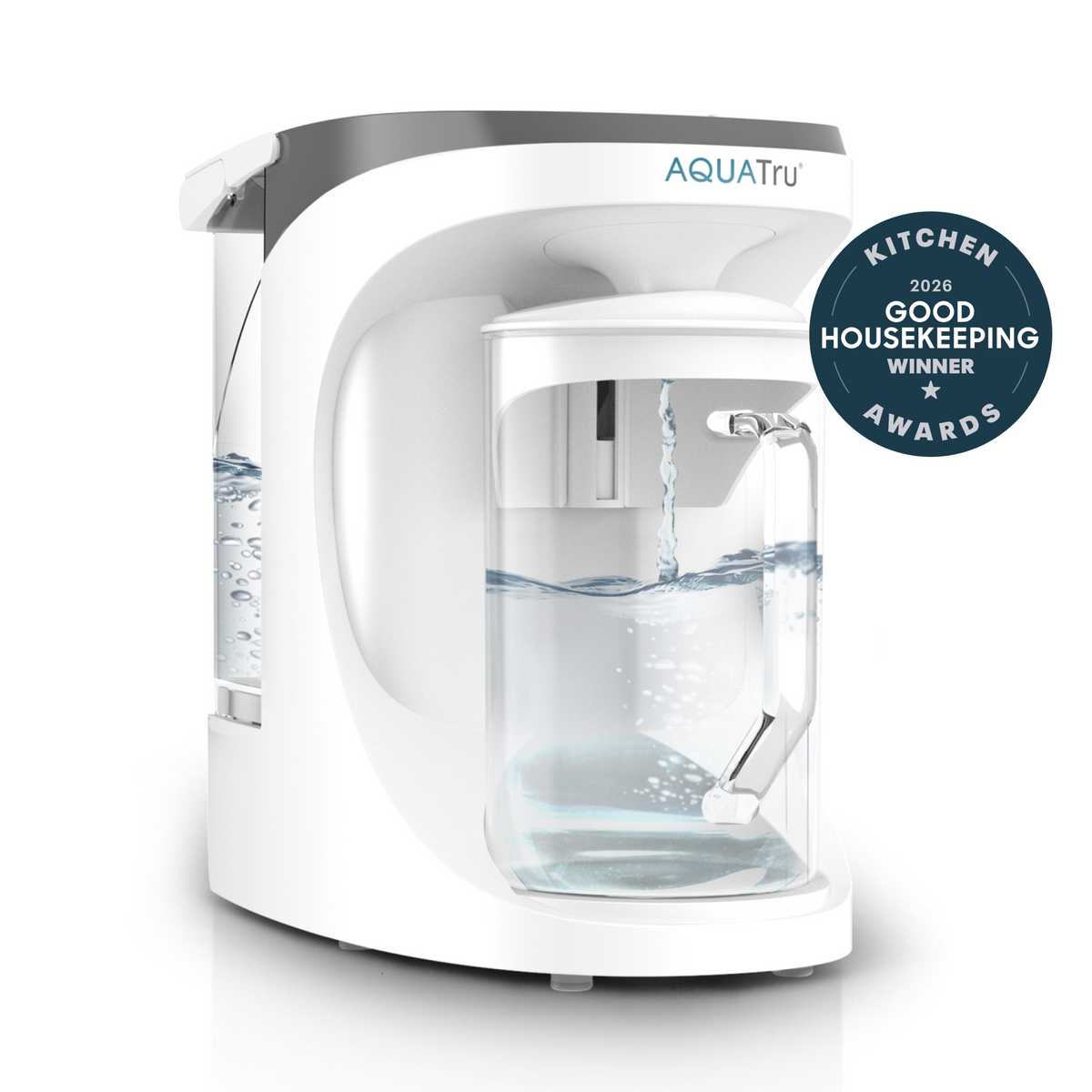
The AquaTru Carafe is designed around a simple idea: give you a countertop reverse osmosis system without taking over the kitchen. Its smaller size and removable glass carafe make it particularly interesting for one or two people or anyone with limited countertop space. AquaTru lists the system at 7.5 inches wide, 14 inches deep, and 13 inches high, with a 0.66-gallon tap-water tank and a 0.5-gallon clean-water carafe.
The practical advantage is that you do not need to install anything under the sink or connect the system to your faucet. You fill the water tank, let the machine process it, and collect the finished water in the removable glass carafe. The carafe can then be poured directly into a glass, stored in the refrigerator, or taken to the table.
This design makes the AquaTru Carafe feel more like a countertop appliance than a permanently installed filtration system. It can also be moved relatively easily because the entire system weighs about 9 pounds.
The tradeoff is capacity. A 0.5-gallon clean-water carafe is convenient for a small household but can mean more frequent refilling if several people use the system throughout the day. It also requires a 120V electrical outlet.
Pros: Compact design, removable glass carafe, no plumbing, relatively easy to move, and a convenient format for one or two people.
Cons: Limited clean-water capacity compared with larger countertop systems, requires electricity, and may require frequent refilling for higher water usage.
Things to consider: This is a better fit when countertop space and simplicity matter more than having a large supply of filtered water ready at once.
Best for People Who Want Fast, Push-Button Dispensing
Brita Hub Countertop Water Filter System
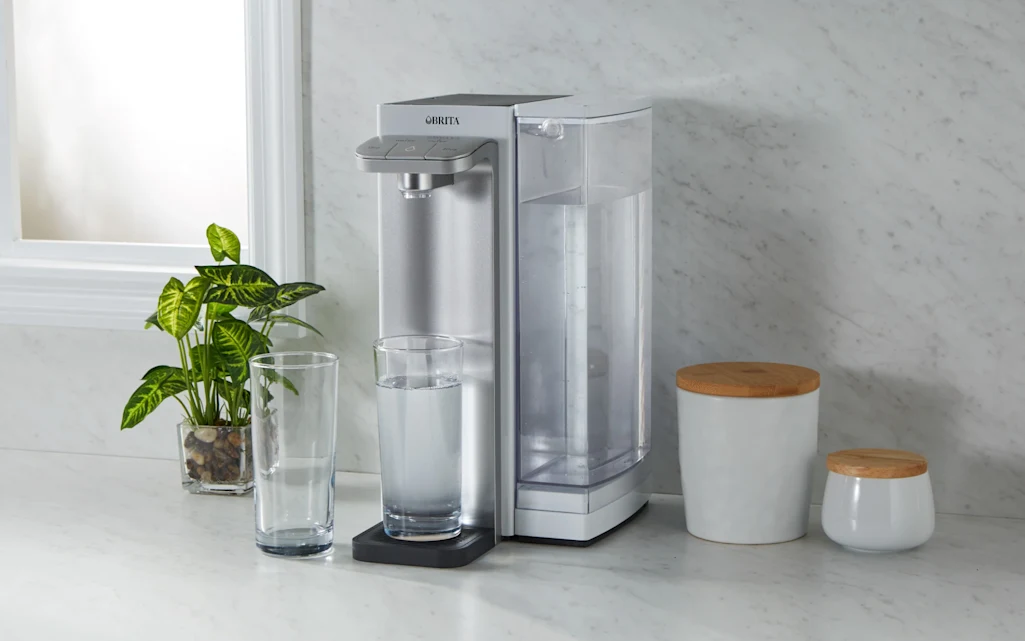
The Brita Hub is aimed at people who want the convenience of an electric countertop dispenser without dealing with a permanent installation. It has a 12-cup reservoir, plugs into an outlet, and provides filtered water through push-button dispensing.
One of its most useful features is the way the reservoir can be positioned. Brita allows the reservoir base to be configured at the back or side of the unit, giving you more flexibility when deciding how to fit it into your countertop layout. That can be useful in kitchens where every bit of counter space matters.
The dispenser also has preset 12-ounce and 20-ounce options as well as manual dispensing. This makes it convenient when you repeatedly fill glasses or bottles and do not want to stand there holding a button the entire time.
The 12-cup reservoir provides more capacity than a small pitcher-style filter, but it is still a reservoir that needs to be refilled. The machine also takes up about 7.5 by 11.4 inches of counter space and stands 14.4 inches high.
Pros: Push-button dispensing, useful preset amounts, flexible reservoir placement, relatively straightforward setup, and a larger reservoir than many small countertop systems.
Cons: Requires electricity, takes up a noticeable amount of counter space, and filtered water is dispensed at room temperature.
Things to consider: Brita says the included filter lasts up to 6 months or 120 gallons, with an indicator light showing when replacement is needed.
Best Countertop RO System for Everyday Use
Bluevua ROPOT Countertop Reverse Osmosis System

The Bluevua ROPOT is aimed at people who specifically want a reverse osmosis system but still want the convenience of keeping everything on the countertop. It is a self-contained system, so there is no permanent plumbing installation.
Its practical design is based around a countertop water tank and a separate glass carafe. The carafe holds about 1,700 ml, giving you a convenient container for storing and pouring the filtered water after the system has processed it.
For someone replacing bottled water, this setup can be useful because you can produce a supply of filtered water at home and keep it ready for drinking instead of repeatedly buying and carrying bottles.
The main tradeoff is that an RO system is generally more involved than a basic countertop carbon filter. The unit needs electricity, has multiple filter components, and requires you to pay attention to filter replacement and water management.
Pros: Countertop RO without permanent plumbing, separate glass carafe, self-contained design, and a format that works well for people who want more comprehensive purification while keeping installation simple.
Cons: Larger and more complicated than a basic countertop filter, requires electricity, and generally costs more to purchase and maintain.
Things to consider: Bluevua lists the ROPOT as a 5-stage RO system and states that its filters can last 12–24 months depending on the filter and usage. Replacement-filter costs should therefore be considered as part of the long-term cost.
Best Budget Countertop Water Filter
Waterdrop ED04
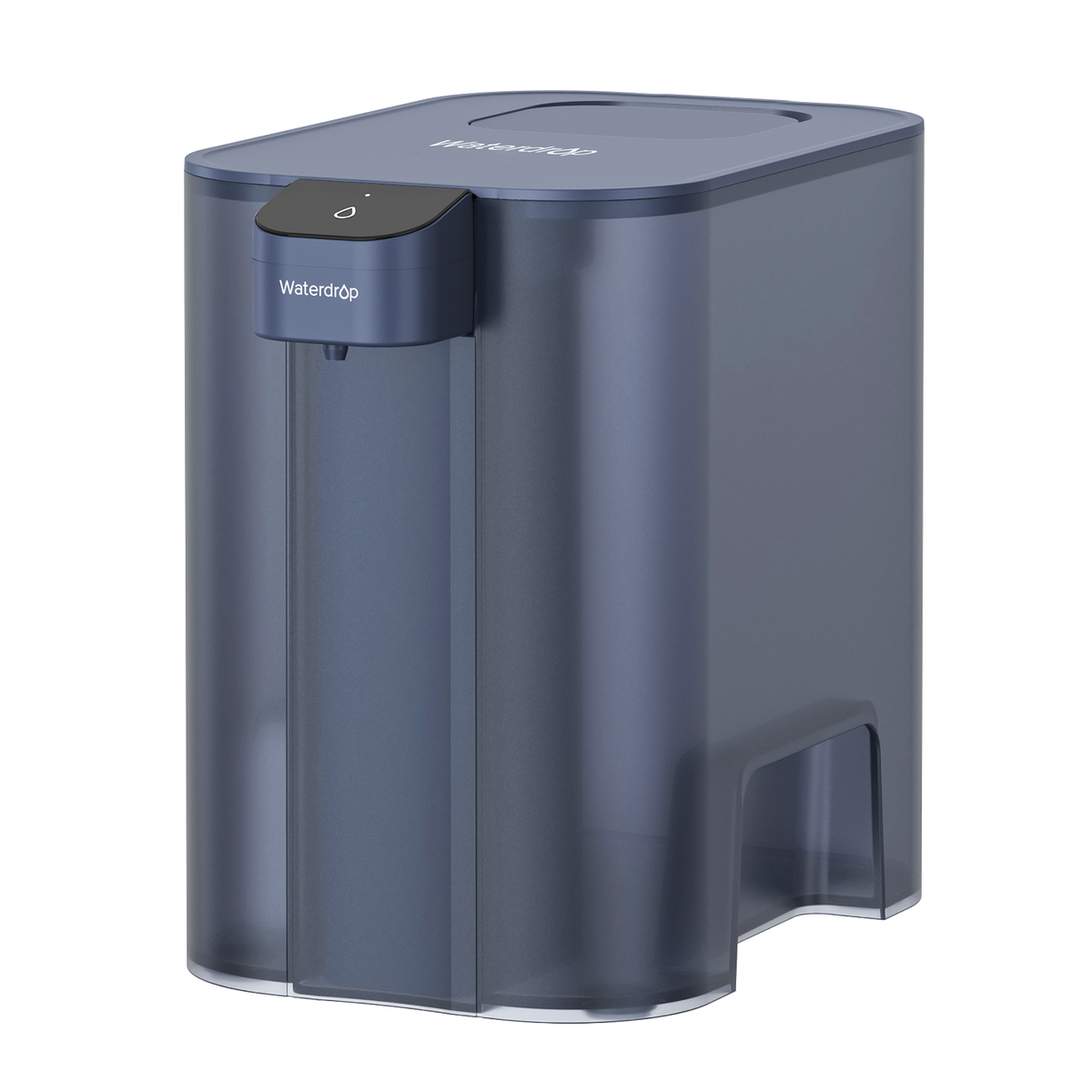
The Waterdrop ED04 is a good example of a simpler electric countertop filter for people who want to move away from a basic pitcher without moving all the way to a more expensive countertop RO system.
Its main advantage is straightforward everyday use. The system has a relatively large feed-water tank and an electric dispensing design, so you can fill the reservoir, leave the unit on the counter, and dispense filtered water when needed. Independent testing data lists the feed tank at about 29.5 cups and the unit at roughly 7.1 by 12 inches, making it a reasonably compact option for its capacity.
The larger reservoir is particularly useful if you do not want to refill a small countertop filter several times a day. The flip-cover design also makes topping up the tank relatively simple.
At the same time, this is still a relatively simple countertop appliance rather than a full reverse osmosis system. That makes it worth considering if your priority is an affordable and convenient way to get filtered water on the counter without paying for features you do not need.
Pros: Large feed-water capacity, compact footprint for its capacity, simple refilling, electric dispensing, and a relatively low initial price compared with many countertop RO systems.
Cons: Requires electricity, still needs regular filter replacement, and its overall filtration approach is less extensive than a countertop RO system.
Things to consider: The ED04 uses a replaceable filter rated for about 200 gallons or 3 months according to the testing/specification data cited above, so replacement-filter frequency is an important part of its ownership cost.
Final Thoughts
A countertop water filter is a good fit if you want filtered water at home without installing a permanent system under the sink, changing your plumbing, or giving up the convenience of having the filter right where you use it.
The main question is not whether one countertop filter is universally better than another. It is whether the way a particular system works fits your daily routine.
If you want the simplest setup, look for a countertop filter with a built-in water reservoir. If you do not want to refill a tank and prefer water to come directly from the faucet, a faucet-connected system may make more sense. If convenience and automatic dispensing are your priorities, an electric countertop purifier can make everyday use easier. And if you specifically want reverse osmosis without an under-sink installation, a countertop RO system gives you that option.
Once you have chosen the type, compare the things you will actually deal with every day: how much counter space it takes, how much water it holds, how quickly it produces water, how often you need to refill it, whether it needs electricity, how easy it is to clean, how much replacement filters cost, how noisy it is, and whether you can easily move it.
From there, choosing a model becomes much simpler. You do not need to find the filter with the longest feature list. You need the one whose size, capacity, speed, maintenance, and operating cost match the way you intend to use it.
So, if what you really want is simply filtered water from a device that stays on your countertop, a countertop water filter is likely the right category to consider. The best model for you is then the one that makes getting and using that water easiest in your own kitchen.
Thanks for sharing such great information. It is really helpful to me. You should also consider Water for Life USA for the countertop Water filters. They are one of the leading distributors of Water filters in the US.