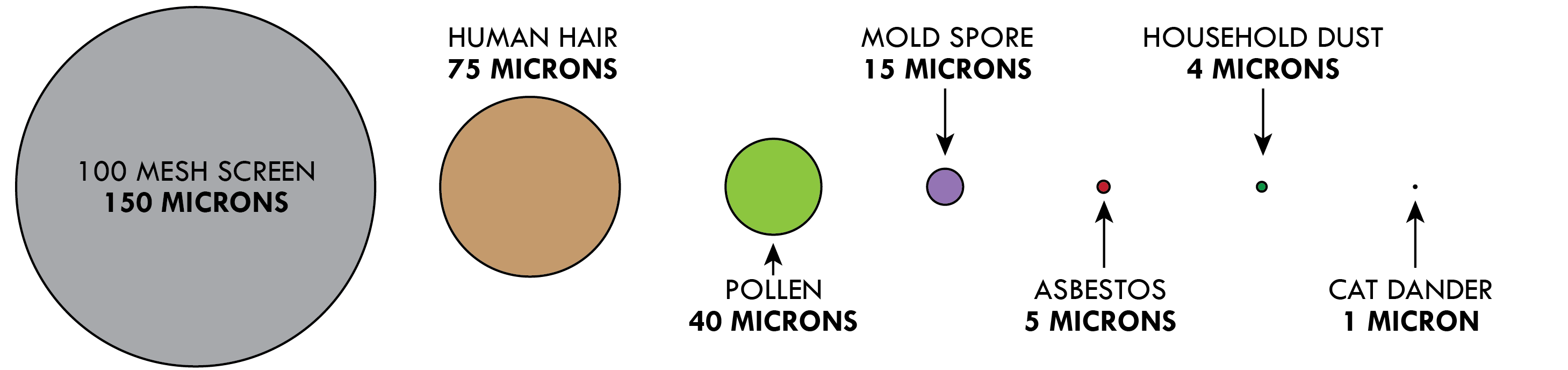
1 Micron vs 5 Micron
Which one is better? How Micron Rating Affects Flow and Filter Life?
A 1-micron filter provides finer particulate filtration than a 5-micron filter, but finer does not automatically mean better. The right choice depends on how much sediment is in your water, what you want the filter to capture, where the filter is installed, and how much flow the system needs.
If you are choosing between the two, 1 micron is generally suited to finer sediment filtration, while 5 micron is often a more practical choice for general sediment filtration or as a prefilter. When water contains a lot of sediment, using a coarser filter before a finer one can also help prevent the finer cartridge from loading too quickly.
What Does a Water Filter Micron Rating Mean?
A micron is a unit of length equal to one-millionth of a meter. In water filtration, the micron rating is used to describe how fine a filter is designed to be at capturing particulate matter.
A Smaller Micron Rating Means Finer Filtration
The basic relationship is straightforward:
50 micron → 20 micron → 10 micron → 5 micron → 1 micron
As the micron rating gets smaller, the filter is designed for finer particulate filtration. A 1-micron rating is therefore finer than a 5-micron rating.
However, the micron number should not be treated as a simple quality score. A filter with a smaller rating may not be the right choice if it has to handle a large amount of sediment or if the system requires high flow.
Nominal vs. Absolute Micron Ratings
Two filters carrying the same micron number do not necessarily perform identically. Micron ratings can be specified using different rating methods, such as nominal or absolute ratings, and actual performance also depends on the filter media and cartridge design.
When comparing filters, look beyond the number printed on the cartridge and check how the manufacturer defines its micron rating.
1 Micron vs 5 Micron: Which Should You Choose?
A 1-micron filter provides finer particulate filtration than a 5-micron filter, but that does not make it the better choice for every water system.
| 1 Micron | 5 Micron | |
| Filtration | Finer | Coarser |
| Smaller particles | Better suited | Less fine |
| Heavy sediment | Can load faster | Often more suitable as a first stage |
| Flow considerations | May become more restrictive as it loads | Often suitable for general sediment filtration |
| Typical role | Finer filtration | General sediment or prefiltration |
These are general differences rather than guarantees. Cartridge size, filter media, water quality, system pressure, and flow requirements can all affect how a particular filter performs.
When Does a 1 Micron Filter Make Sense?
A 1-micron filter makes sense when the goal is finer particulate filtration and the water entering the cartridge does not contain so much sediment that the filter quickly becomes loaded.
It can be useful when you want to capture smaller suspended particles than a 5-micron filter is designed to target, particularly when a coarser filtration stage has already removed much of the larger sediment. It can also make sense when the filter is being used as a finer stage rather than as the first line of defense for heavily sediment-laden water.
The important point is that choosing 1 micron should be based on the filtration job, not simply on the assumption that a smaller number is always better.
When Does a 5 Micron Filter Make Sense?
A 5-micron filter is often a practical choice for general sediment filtration when you want finer filtration than a coarser 10-, 20-, or 50-micron filter without immediately moving to a very fine rating.
It can also work well as a prefilter when another filtration stage follows it. In that arrangement, the 5-micron cartridge can remove a significant portion of suspended sediment before water reaches a finer filter or another treatment stage.
For systems with substantial sediment, a 5-micron filter may also be easier to manage than starting with a 1-micron cartridge, although the actual filter life and flow performance depend on the water and cartridge design.
When Does It Make Sense to Use Both?
Using both ratings can make sense when the water contains a mixture of larger and smaller sediment and one cartridge is not well suited to handling the entire load.
The basic approach is:
Coarser filtration → finer filtration
A coarser filter can capture larger sediment first, allowing the finer filter downstream to focus on smaller particles. This can help reduce the amount of sediment reaching the finer cartridge and may extend its useful life.
There is no universal sequence that every water system should follow. The appropriate combination depends on the sediment load, required flow, cartridge specifications, and the purpose of each filtration stage.
What About 10, 20, 30 and 50 Micron Filters?
Micron ratings can be viewed as a spectrum rather than a series of separate choices:
50 micron → 30 micron → 20 micron → 10 micron → 5 micron → 1 micron
Moving from left to right means progressively finer particulate filtration. The important question is not which rating is universally better, but what job the filter needs to perform.
Coarser Ratings: 20–50 Microns
Filters in the 20–50 micron range are designed for coarser particulate filtration. They can be useful when water contains visible sediment such as sand, grit, or other larger particles, particularly when a filter needs to handle a relatively high sediment load.
Because they allow larger particles to pass compared with finer filters, these ratings can work well as a first-stage filter. Removing larger sediment before water reaches a finer cartridge can help prevent the downstream filter from loading too quickly.
The specific difference between 20, 30, and 50 microns matters less than the overall role of the filter: handling larger sediment before finer filtration.
Mid-Range Ratings: 5–20 Microns
The 5–20 micron range covers several common sediment-filtration choices. A 5-micron filter provides finer particulate filtration than a 10- or 20-micron filter, while 10 and 20 microns are progressively coarser.
That does not mean a 5-micron filter is automatically a better choice than a 20-micron filter. A 20-micron cartridge may be well suited to removing larger sediment as a prefilter, while a 5-micron cartridge can provide finer filtration farther downstream.
The right rating depends on how much sediment the cartridge must handle, how fine the filtration needs to be, and whether the cartridge is being used alone or as part of a staged setup.
Why the Smallest Number Is Not Always the Goal
The goal is not to choose the smallest micron number. The goal is to choose a rating that matches the sediment, flow requirements, and position of the filter in the system.
How Micron Rating Affects Flow and Filter Life
Choosing a finer filter can change more than the size of particles it captures. It can also affect how quickly the cartridge loads with sediment and how much resistance the water encounters as it passes through the filter.
Can a Smaller Micron Filter Reduce Water Flow?
A finer filter can create more resistance to water flow, but the effect depends on more than the micron rating alone. Cartridge size, filter media, housing, water pressure, flow rate, and the amount of sediment already trapped in the cartridge all affect the final result.
As a cartridge becomes loaded with sediment, its resistance can increase. This means a filter that initially provides adequate flow may deliver less flow as it accumulates particles.
For this reason, switching from a 5-micron filter to a 1-micron filter should not be assumed to cause a specific pressure or flow reduction. The actual effect depends on the particular cartridge and system.
Why Does a Fine Filter Clog Faster?
A finer filter can load more quickly when a large amount of sediment reaches it because it is designed to capture smaller particles that a coarser filter would allow through.
The basic process is:
More sediment reaches the fine filter → the filter loads → resistance increases → flow can decrease → the cartridge needs replacement.
This is one reason a 1-micron filter may not be the most practical first-stage choice for water with heavy sediment. A coarser filter can handle larger particles first, leaving the finer cartridge to perform the more demanding filtration downstream.
When Should You Use a Coarser Prefilter?
A coarser prefilter can make sense when the incoming water contains enough sand, grit, or other sediment to quickly load a finer cartridge.
The basic approach is:
Heavy or coarse sediment → coarser first stage → finer downstream stage
The purpose is not to add filtration stages simply for the sake of having more filters. It is to prevent the finer cartridge from having to handle the entire sediment load at once. The appropriate arrangement depends on the amount of sediment, required flow, and specifications of the cartridges being used.
Does Your Filter Need a Different Micron Rating?
If you are replacing a filter or dealing with clogging or flow problems, start with the job the cartridge needs to perform rather than simply choosing a smaller micron number.
| If this is your situation | Consider |
| You see sand, grit, or heavy sediment | A coarser first-stage filter |
| You need finer sediment filtration | A lower micron rating |
| Your 1-micron filter clogs quickly | More prefiltration or a coarser first stage |
| Flow drops as the filter loads | Check sediment loading, cartridge size, and micron rating |
| You need general sediment filtration | A mid-range rating may be sufficient |
| You want to remove dissolved contaminants | Look beyond micron rating |
1. What Are You Trying to Remove?
If the problem is suspended sediment or particles, the micron rating is directly relevant. If you are trying to remove dissolved contaminants, however, micron size alone is not the appropriate measure. You may need a different filtration or treatment technology designed for that contaminant.
2. How Much Sediment Is Entering the Filter?
The amount of sediment matters because a fine filter can become loaded quickly when it receives a large particle load. If your water contains substantial sediment, choosing the smallest available rating may create unnecessary clogging or flow problems.
3. Is the Filter a First Stage or a Final Stage?
A first-stage filter often needs to handle larger sediment before water reaches finer filtration. A downstream or final-stage filter can be selected for finer particulate filtration when the incoming sediment load has already been reduced.
4. Are You Having Pressure or Clogging Problems?
If flow is dropping or a cartridge is clogging quickly, changing only the micron rating may not solve the problem. Check the amount of sediment entering the filter, cartridge size, system flow requirements, and whether additional prefiltration is appropriate.
Choose the micron rating based on what the filter needs to do, how much sediment it must handle, and where it sits in the system.